
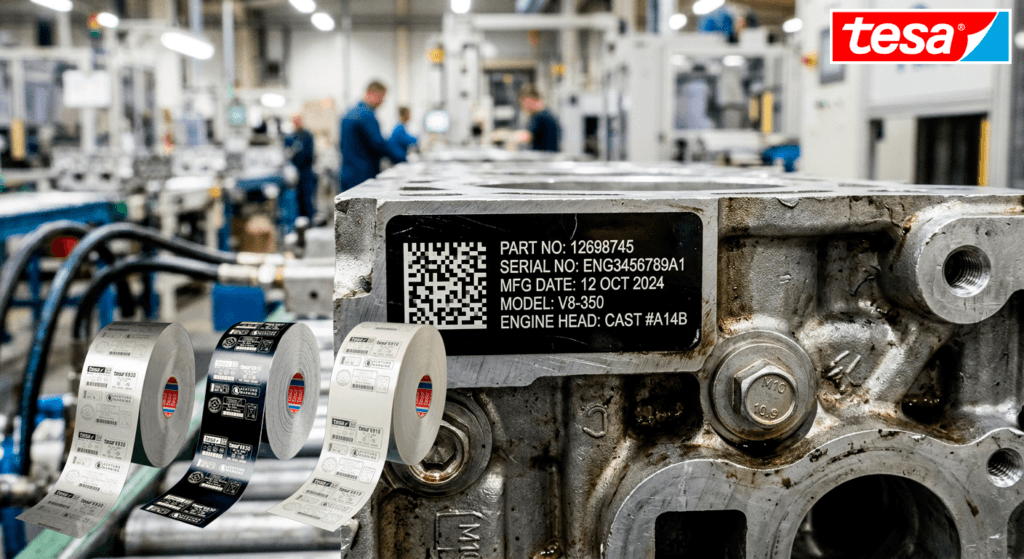
TESA Laser Labels
In many modern factories and workshops, traditional labelling has proved inadequate. When a part undergoes chemical treatments, is subjected to very high temperatures or needs to bear a serial number that lasts for its entire service life, a conventional paper or polyester label ends up fading or peeling off. The tesa® Laser Label range was developed to solve these problems: these are acrylic sheets designed to be laser-engraved and cut directly on the assembly line. From a single plain roll, you can instantly produce labels of any shape and size, saving space and ensuring that no one can forge or remove the identification without leaving a trace.
How does Tesa® laser labelling technology work?
The secret behind these tesa laser labels lies in their two-layer structure and the very fragility of the material itself
- Two-level contrast engraving: The sheet consists of a coloured top layer and a bottom layer of a contrasting colour. When the laser beam strikes it, it evaporates the surface film with complete precision, revealing the background. This allows QR codes to be produced with greater clarity than with traditional inks.
- Security against theft or tampering: The acrylic material is designed to break easily if anyone attempts to peel it off. Once the adhesive has set on the surface, it is impossible to remove the label in one piece.
- Resistance to extreme conditions: They easily withstand continuous abrasion, industrial solvents, oils, ultraviolet rays and temperatures of up to 270 °C, keeping the data legible for years.
Comparison of the main TESA® Laser Label products
| Reference | Main focus | Thermal resistance | Distinguishing feature |
| tesa® 6930 | Universal | Up to 250 °C | The most versatile in terms of colours (black, silver and white – gloss or matt). |
| tesa® 6940 | High speed | Up to 270 ºC | Designed for high-speed production lines without compromising on sharpness. |
| tesa® 6947 | Speed + Anti-fraud | Up to 270 ºC | It includes a watermark embedded in the film itself. |
| tesa® 6957 | Maximum security | Up to 250 °C | It incorporates hidden anti-counterfeiting features (ideal for frames). |
| tesa® 6973 / 6974 | Specific lasers | Up to 250 °C | Tailored to specific wavelengths in precision electronics. |
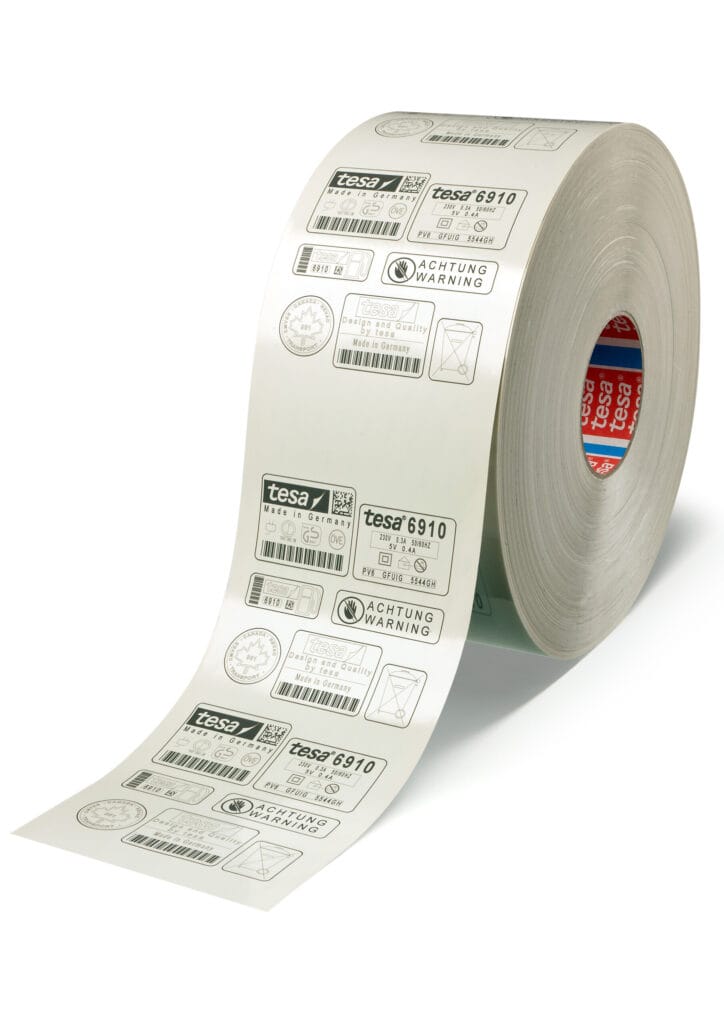
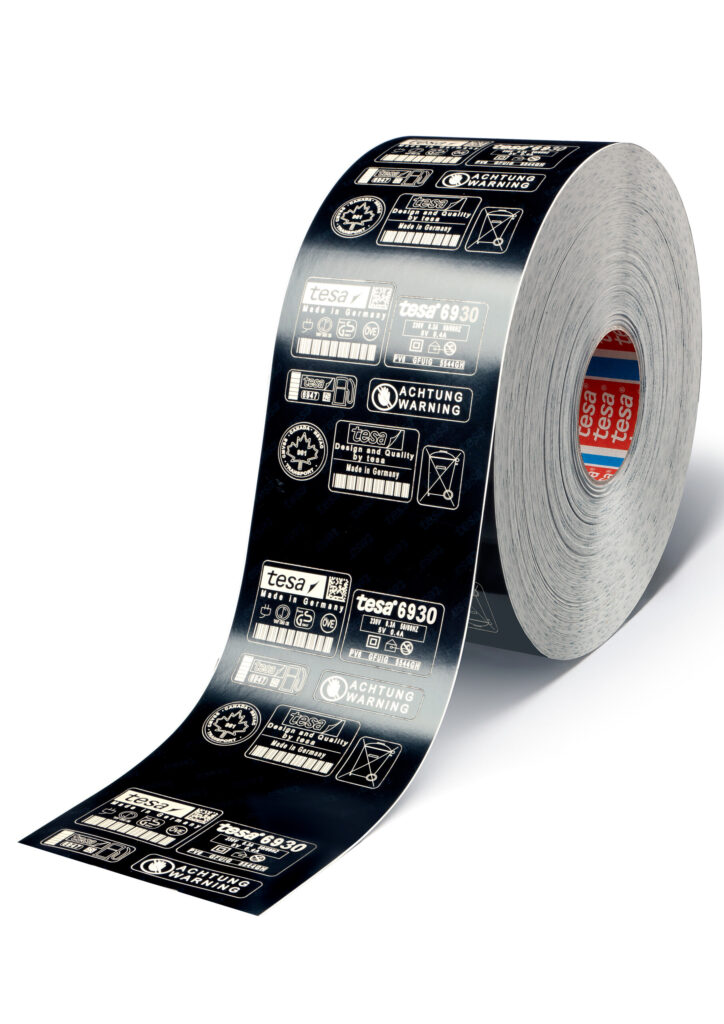
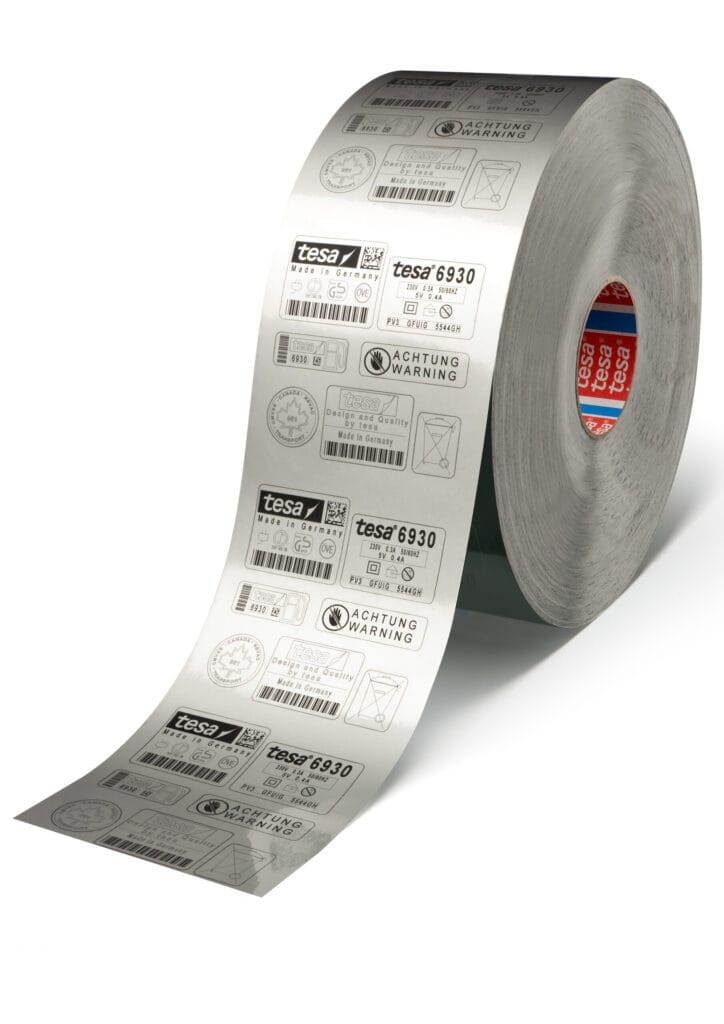
Applications – Where are they used?
As they allow tesa laser labels to be customised at the last minute, these films have become indispensable in numerous industrial sectors:
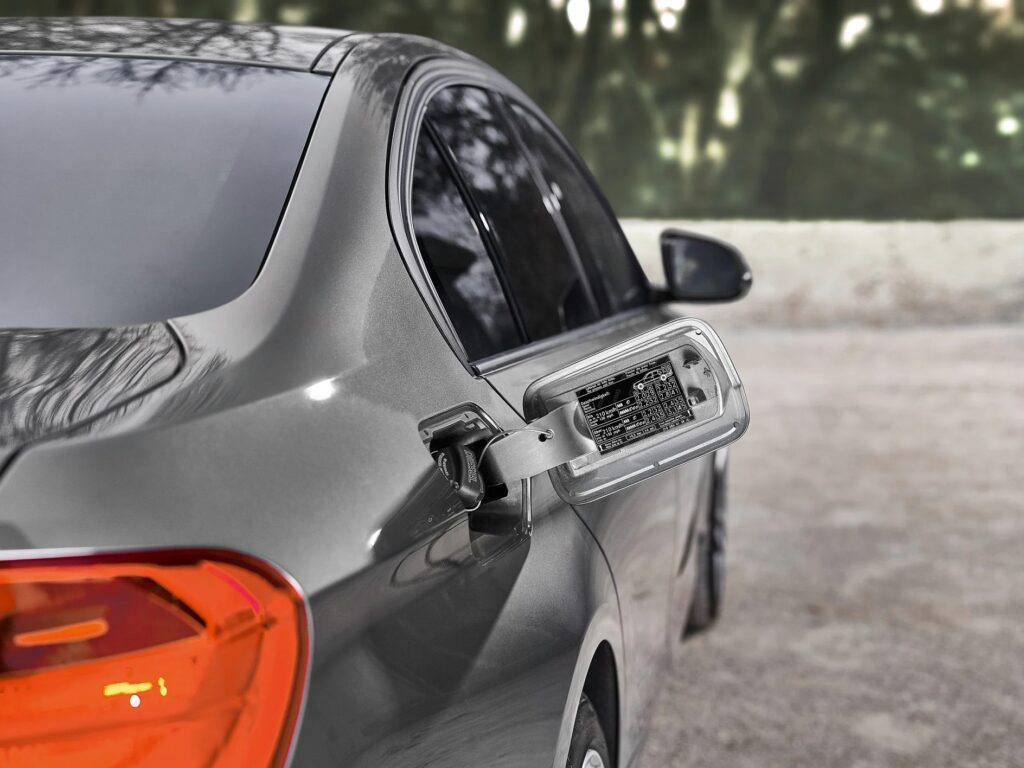
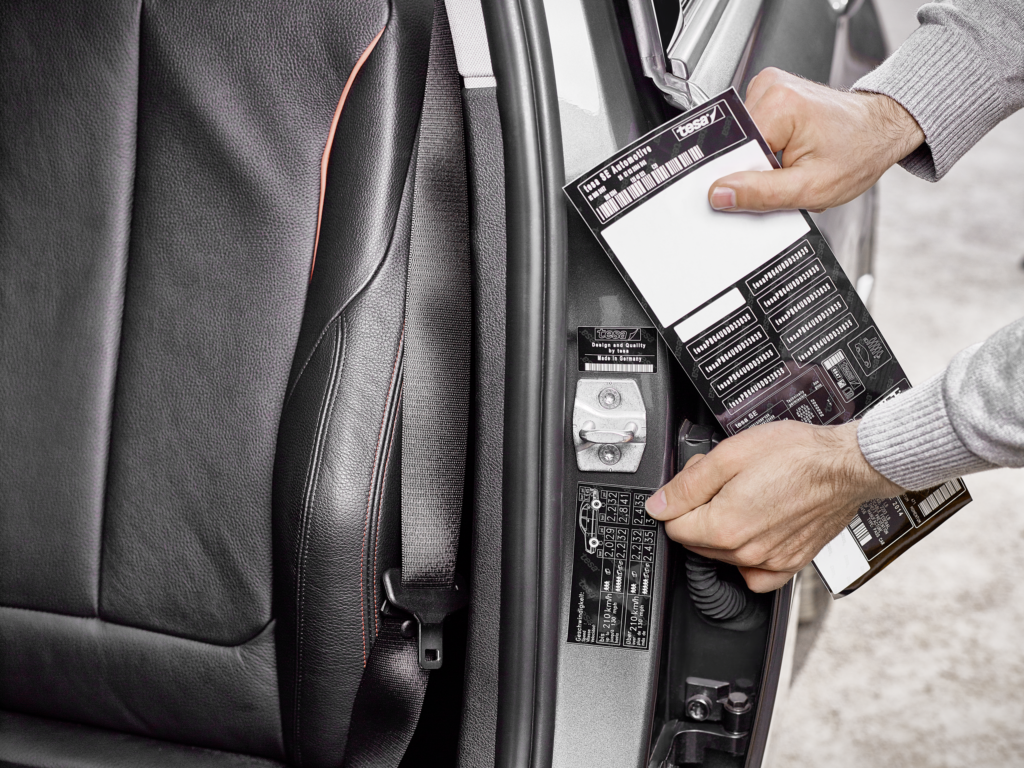
- Automotive industry: They are used for engraving vehicle identification numbers (VINs), tyre pressure labels on door frames, warnings in the engine compartment and the traceability of critical components such as airbag modules or electronic control units, where heat and fluids would destroy a standard label.
- Electronics and household appliances: As they can engrave very small codes without losing contrast, they are commonly found on motherboards, electric vehicle batteries, mobile phones and household appliance motors, ensuring that the serial number remains intact throughout the warranty period.
- Industrial machinery and professional tools: They serve as technical specification plates (showing voltage, CE standards and batch numbers) on motors, hydraulic pumps or power tools that operate outdoors or in environments subject to grease and abrasion.
- Security and warranty control: Any manufacturer needing to seal a casing to check whether a user has opened the equipment uses these labels as a tamper-proof warranty seal.
What do the PV suffixes mean?
- PV3 (The standard format): It has a total thickness of between 90 and 110 microns and a standard layer of adhesive (25 g/m²). It is the usual choice for smooth surfaces, painted metals or parts with gentle curves.
- PV6 (The reinforced version): This has a thickness of around 140–145 microns and a higher adhesive load (35 g/m²). This extra thickness makes it much easier to handle, both manually and in automatic dispensers, and the additional adhesive ensures a firm hold on difficult plastics or slightly rough surfaces.
- PV1, PV5 and PV8: These are specific colour or face variants. For example, the suffix PV8 identifies the glossy white finish within product code 6930, whilst PV1 and PV5 are used in high-security models such as 6947 or 6957.
- AF48 (Invisible UV mark): This is a special finish applied to the PV6 base. If someone manages to remove the label completely using chemicals or extreme heat, the adhesive leaves a fluorescent mark on the item that is detectable when illuminated with ultraviolet light.
What should you bear in mind before implementing tesa® laser labels on your production line?
- Compatibility with your laser equipment: Although CO₂ lasers, Nd:YAG lasers and fibre lasers (Yb:YAG) generally work very well, each lens type responds best to a specific wavelength. It is advisable to carry out a contrast and cutting test before finalising your choice of lens.
- Fume extraction: Vaporising the top layer with a laser generates particles and gases. A good extraction and filtration system must be in place near the laser head to keep the lens clean and protect operators.
- Adhesive curing time: Although initial bonding is rapid, the acrylic adhesive reaches its maximum bond strength after approximately 24 to 72 hours. If you are carrying out pull-off tests to check the tamper-evident effect, wait at least one day after bonding to see the actual result.
Other interesting publications: